Structural Drying in Eagan, MN
The water is gone. You spent Saturday with a rented extractor and Sunday with every fan in the house pointed at the lower-level carpet. On Wednesday the room still smells like a wet dock, the baseboards have started to lift, and the drywall by the walkout door gives under your thumb. This site connects you by phone with an independent local provider who dries out houses in Eagan and the Dakota County suburbs.
Reading the walls before placing a single fan
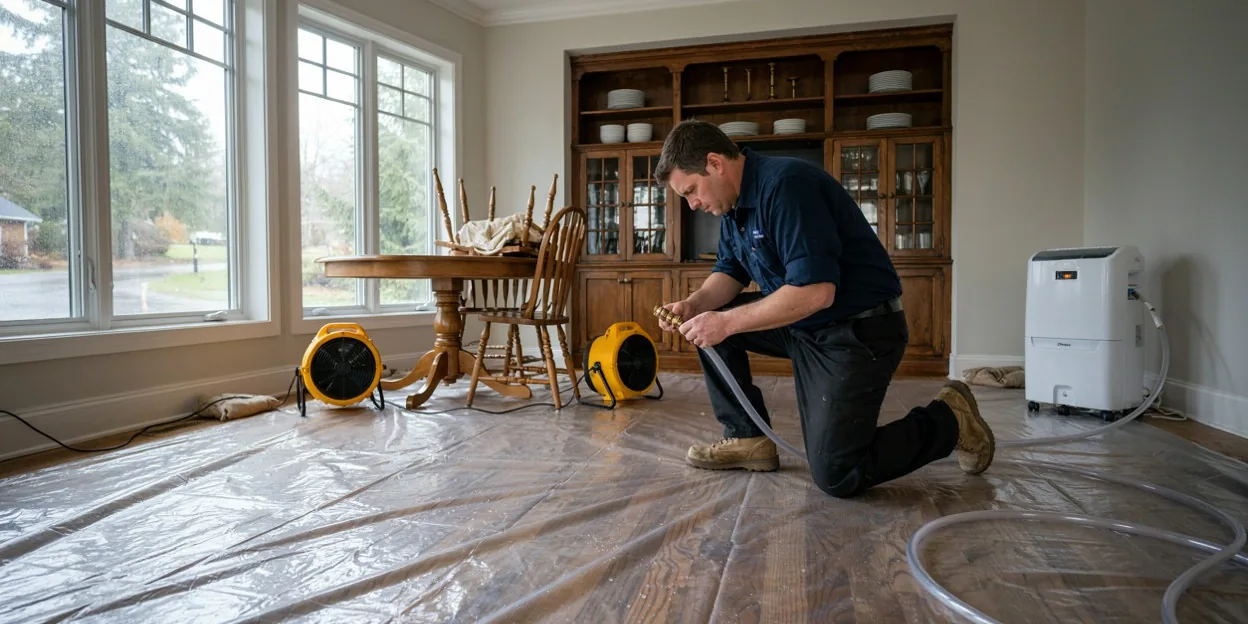
The crew does not start by setting up equipment. They start by metering the drywall at the base of every wall, the subfloor if there is one, the studs where a wall is open, and the concrete under the carpet, and they compare each reading to a dry spot of the same material upstairs. Those numbers say what is wet, how wet, and where the drying has to happen. A wall that reads dry gets no equipment; a wall that reads wet behind the paint gets an air mover aimed along it and sometimes a small hole at the base so air reaches the cavity.
Then the dehumidifiers go in. Air movers push water out of the material into the air. Dehumidifiers pull it out of the air so it does not settle back into the next room. Both run around the clock, and the crew comes back to take readings and move equipment as areas dry.
What to do while the equipment runs
Leave it running. The most common reason a drying job fails is somebody shutting the dehumidifier off at night because of the noise. Keep the doors to the drying area closed so the equipment works on a small volume of air. Keep the lower level heated in winter, because cold air holds almost no water and drying slows to a crawl below about 60 degrees. Ask the crew which rooms you can use and which need to stay closed.
When materials dry in place and when they do not
Framing, subfloor, and concrete almost always dry in place if the crew gets to them within a few days. Drywall that got wet at the bottom and stayed wet for a week usually comes off at two feet. Carpet dries once the pad is gone; pad does not. Insulation in a wet wall comes out. A cupped hardwood floor on the main level of an older Eagan colonial gets drying mats and a few days before anyone decides on replacement.
The job ends when the readings reach the dry target on every material that started wet, not when the room feels dry to the hand. That final set of readings is what closes the drying log. If a below-grade level stays damp on its own after the equipment leaves, a permanent dehumidifier installation is the next conversation.
Drying a house through a Minnesota winter and a Minnesota summer
Eagan gives a drying crew two opposite problems. In January the outside air is dry but the house is sealed tight and the lower level of a split-level runs cold, so the crew has to bring the temperature up before the equipment does much. In July the outside air is so humid that opening the walkout door makes things worse, and the dehumidifiers do all the work.
Most of the housing here dates to the 1970s through the 1990s and puts the family room, laundry, and utility room on one below-grade slab. Water that started at a washing machine overflow or a dead sump pump spreads under the carpet across the whole level, and the drying has to cover the whole level too, not just the room with the puddle. The lower levels that flood in a thunderstorm are the same ones that weep along the walkout wall each April when the frost goes out.
The drying log matters for your claim. Many policies pay for a sudden loss and expect the homeowner to dry the house promptly; a wall left wet for weeks becomes a harder conversation with the adjuster. This site makes no promise about coverage. Ask the crew for the daily readings on paper.
Calling about a house that will not dry
Say when the water came in, what you have done so far, and which rooms still feel damp or smell. Mention whether the lower level is finished and whether the heat is on down there. Call (651) 433-7589.